
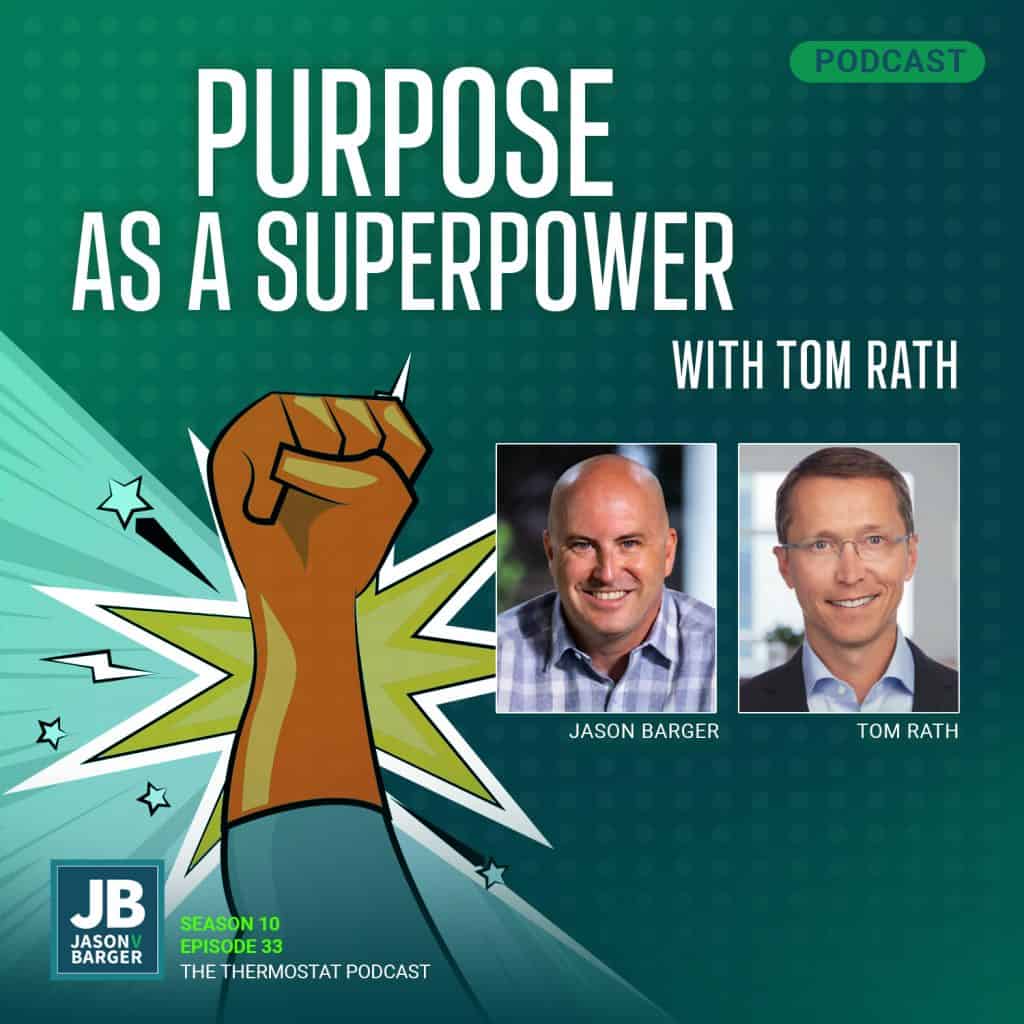
Purpose is the greatest superpower people and organizations have in the world today. The best leaders and cultures know how to unleash their people by staying focused on the point.


SHOW NOTES
Jason introduces Season 10 episode 33 of the podcast, Purpose as a Superpower with Tom Rath. Welcome back to the podcast on corporate culture and leadership and thank you for listening. We engage thought leaders like CEOs, CFOs, managers, VPs, directors, and more for this podcast. We wish to create content that engages your mind and heart and allows you to step back and think and add some positivity to your life. We deep dive into today’s topic.
We can’t control everything but what we can control is our response. Still a lot of work to do but wanted to remind the audience what is within our control is the temperature we create in the organizations and teams we work with.
Please leave a review for the podcast It really helps the podcast to spread these messages out into the world. Please share this podcast with your organization, on your team, or in your life to help spread these messages. Thank you!
If any of these topics are interesting to you please or you want a deep dive on any specific topics, please reach out to us here
Purpose as a Superpower with Tom Rath
Executive Summary
In a fast-moving, hyper-connected workplace, professionals and executive teams often struggle with burnout, engagement slumps, and a lack of direction. On this episode of The Thermostat Podcast, host Jason V. Barger is joined by Tom Rath—#1 New York Times bestselling author of StrengthsFinder 2.0, How Full Is Your Bucket?, and What’s the Point? Turning Purpose into Your Daily Superpower.
Together, they challenge the traditional corporate hustle, reframe how we view individual strengths, and outline how everyday interactions can become a strategic advantage for corporate culture and leadership in teams. By shifting focus away from vague, grand ideas of “passion” and focusing instead on daily micro-purposes, leaders can build high-performing environments anchored in human well-being and genuine contribution.
The Myth of the “Grand Purpose”
For decades, career advice has urged people to go out and “find their purpose”—as if meaning were a single, grand revelation descending from the sky on a sunny day. For 90% of working professionals, this framing produces anxiety rather than clarity.
Tom Rath suggests a far more practical, everyday approach: treat purpose like a garden you tend to daily. Instead of searching for one overarching destiny, purpose is built by asking simple diagnostic questions throughout your day:
-
What is the point of this 30-minute team meeting?
-
What is the point of answering these emails right now?
-
How will this conversation support a colleague or client?
When leaders cultivate 5 to 15 purposeful interactions within a single workday, meaning accumulates organically. This micro-purpose mindset turns daily effort into a sustainable superpower.
Why “Follow Your Passion” Falls Short
“Follow your passion” remains staple advice for incoming graduates, but it carries a fundamental flaw: passion starts and ends with you. You can be deeply passionate about playing basketball or traveling, but that passion alone does not guarantee a positive contribution to society or align with your actual strengths.
┌─────────────────────────────────────────────────────────────┐
│                    PASSION vs. PURPOSE                      │
├──────────────────────────────┬──────────────────────────────┤
│ PASSION                      │ PURPOSE                      │
│ • Self-centric ("What I like")│ • Outward-focused ("What others│
│ • Can lack practical impact  │   need")                     │
│ • Risk of superficial focus  │ • Anchored in contribution   │
│                              │ • Builds collective meaning  │
└──────────────────────────────┴──────────────────────────────┘
Effective leadership in teams requires connecting individual strengths with external needs. Self-awareness tools like StrengthsFinder are only useful when applied outwardly. True organizational alignment occurs when professionals ask: What do the people around me need, and how can I leverage my unique strengths to meet that need?
Dismantling the 100-Year Industrial Grind
A century-old industrial mindset continues to shadow modern corporate environments. Traditional managers often equate long hours, eating lunch over a keyboard, and responding to emails from the beach with elite productivity.
Yet, research demonstrates that chronic sleep deprivation and non-stop grinding leave workers operating with the cognitive equivalent of mild intoxication by late afternoon.
| Traditional “Hustle” Mindset | Modern Purpose & Energy Mindset |
| First in, last out; working 24/7 | Prioritizes daily recharge and 7–8 hours of sleep |
| “All gas, no brakes” mentality | Respects personal biorhythms and energy cycles |
| Superficial wellness initiatives | Leaders actively model healthy boundaries |
| Transactional task management | Connects daily workflows to shared purpose |
Leaders set the emotional and physical temperature for their teams. If an executive preaches work-life integration while sending late-night emails, the team hears the real message loud and clear: Well-being is optional; constant availability is mandatory. Building a high-performing corporate culture requires leaders to model rest, movement, and boundaries as essential tools for long-term output.
Leveraging AI: Shifting from Responders to Builders
Artificial Intelligence and automated tools are reshaping workplace expectations. Rather than viewing technological advances purely as a cost-cutting mechanism to replace human effort, forward-thinking organizations treat AI as an opportunity to amplify human creativity.
To stay relevant, professionals must shift from being passive responders (scrolling, reacting, and answering) to active builders (creators and innovators using technology to scale impact):
[ Passive Responders ] ──(Risk of Automation)──► Task Obsolescence
[ Active Builders ]    ──(Leveraging AI Tools)──► 5x-10x Scaled Impact
By offloading routine administrative tasks to digital tools, leaders free up mental bandwidth to focus on complex problem-solving, strategic planning, and building human connections.
Culture as the Ultimate Connective Tissue
Employee engagement statistics highlight a significant trust gap in contemporary business. Gallup data reveals that employee engagement has hit a 10-year low, with only 23% of workers trusting their leadership’s future direction. Furthermore, while 90% of employees express a desire to feel connected to their company’s culture, only 20% report feeling that connection in practice.
┌─────────────────────────────────────────────────────────────┐
│                 THE WORKFORCE TRUST GAP                     │
│                                                             │
│ Desires Cultural Connection [90%] ────────────────► ███████ │
│ Trusts Leadership Direction [23%] ─────────► ██             │
│ Feels Connected to Culture [20%] ──────────► ██             │
└─────────────────────────────────────────────────────────────┘
Culture is not an administrative add-on or a poster on the lobby wall; it is present in every interaction, habit, and shared decision. In a hybrid or remote environment, leaders must intentionally create spaces for “congregation”—bringing people together to align priorities, celebrate micro-wins, and reinforce shared purpose.
Notable Quotes
“90% of us, when we hear the word purpose, it just gives us anxiety about some big mythological thing we need to find or chase that descends from the heavens on a sunny day… Purpose is really more like a garden that you tend to and plant seeds in every day.” — Tom Rath
“With any self-awareness tool, if you just go out there and say, ‘This is what I know about myself, I’m going to beat that into the world,’ it’s not very useful. We really need to start by looking at what people around us need and then connecting those dots back.” — Tom Rath
“If you’re not being a good role model and example in your own life… and you’re still emailing when you’re at the beach, no one else feels permission to do anything else in your culture or in your work team.” — Tom Rath
“Culture is not an add-on; it’s in everything that we do. The temperature we set and the culture we create with the people around us is the greatest competitive advantage we have.” — Jason V. Barger
Questions to Ponder
Take time to evaluate these core diagnostic prompts to help calibrate your team’s thermostat and build daily purpose into your leadership practice:
-
Setting Your Baseline Temperature: What precise climate or energy are you bringing to your life, your home, and your team interactions today?
-
Identifying Micro-Purposes: Looking at your calendar for the week ahead, how can you reframe routine tasks and meetings to highlight their connection to serving others?
-
Modeling Well-Being: Are your daily habits modeling sustainable performance for your team, or are you inadvertently signaling that exhaustion is required for success?
-
Shifting to a Builder Mindset: How can you leverage emerging tools and technology to step back from mere administrative reaction and focus on creating long-term value?
Is your team ready to become change-seekers? If you’re looking for further guidance on aligning your vision with action, how can we help you take that next strategic step? – Contact Us Now
Links and References
Learn more about Tom Rath at and see the book What’s the Point? and visit tomrath.org
Follow @JasonVBarger on social media for even more insights and new video content.
For more insights and practical tips, be sure to check out Jason V Barger’s book Breathing Oxygen. This book dives deeper into the concepts discussed in this episode and provides additional strategies for fostering a positive mindset and effective leadership.
By incorporating these practices into your summer routine, you can breathe new life into your personal and professional endeavors. Remember, as Jason says, “The best leaders, teams, and cultures on the planet stimulate progress by recalibrating their thermostat together.”
Please leave a review for the podcast It really helps the podcast to spread these messages out into the world. Please share this podcast with your organization, on your team, or in your life to help spread these messages. Thank you!
If any of these topics are interesting to you please or you want a deep dive on any specific topics, please reach out to us at info@jasonvbarger.com
Listen to more great episodes here
Remember, the best leaders, teams, & cultures stimulate progress by recalibrating their thermostat together.
If you like the podcast, have a question, or just want to share your thoughts about daring to begin please leave a comment below or please leave a review on Apple Podcasts or Google Podcasts.
—

Barnes & Noble Amplify Books Publisher Amazon Books & Kindle
ABOUT THE THERMOSTAT
Conversations and micro-thoughts to engage your mind and heart.
A thermostat is proactive. It sets the temperature in a room. Controls the temperature. Regulates the temperature. But in today’s distracted, fast-paced and digital world, it’s easy for individuals and organizations to act more like thermometers, slipping into reactionary thinking, becoming scattered and inconsistent. The most compelling leaders, teams, organizations, families, or collection of humans of any kind operate in thermostat mode. They calibrate their mind and heart to set the temperature for the vision and culture they want to create. Jason Barger, globally celebrated author, keynote speaker, and founder of Step Back Leadership Consulting, is the host of The Thermostat, a podcast journey to discover authentic leadership, create compelling cultures and find clarity of mission, vision, and values.