
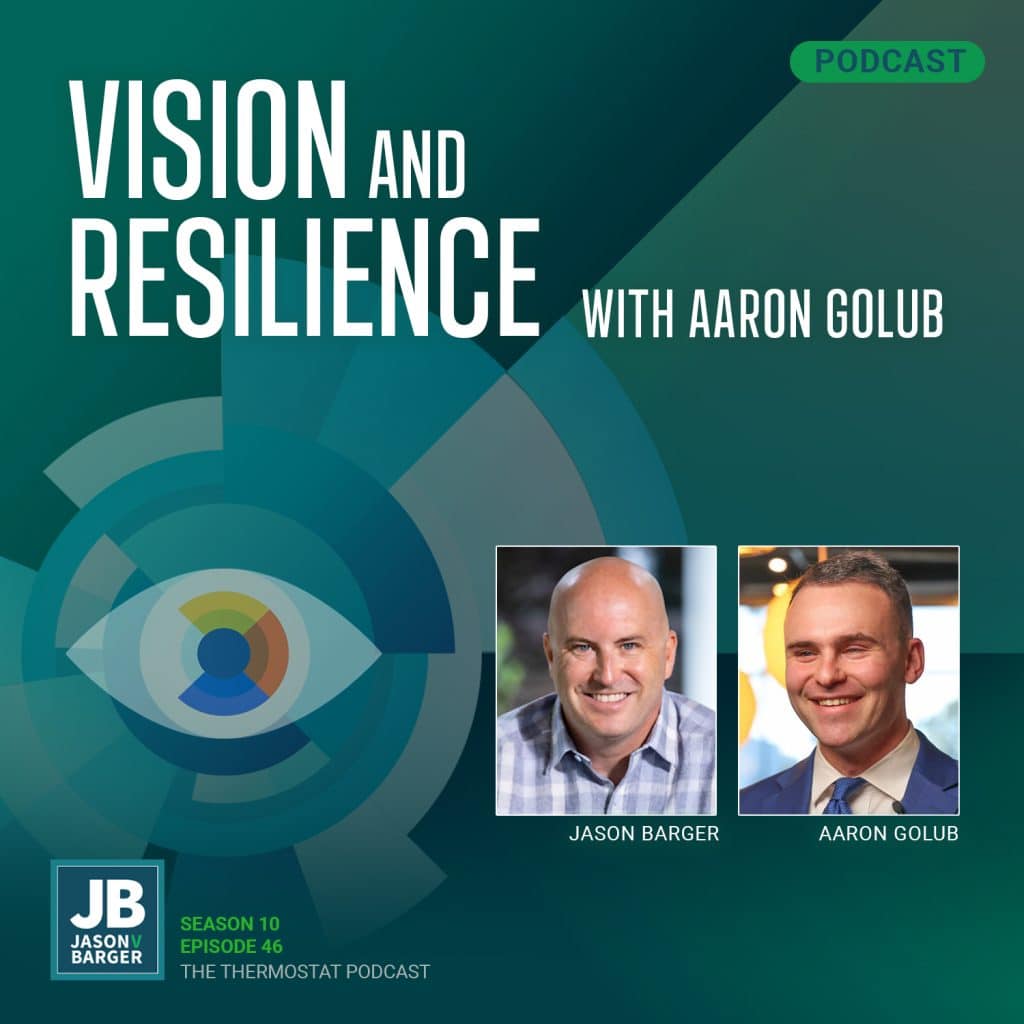
Having vision isn’t all about what you can already see. Resilience is required for every human journey and certainly for developing leaders and organizational cultures.


SHOW NOTES
Jason introduces Season 10 episode 46 of the podcast, Vision and Resilience with Aaron Golub. Welcome back to the podcast on corporate culture and leadership and thank you for listening. We engage thought leaders like CEOs, CFOs, managers, VPs, directors, and more for this podcast. We wish to create content that engages your mind and heart and allows you to step back and think and add some positivity to your life. We deep dive into today’s topic.
We can’t control everything but what we can control is our response. Still a lot of work to do but wanted to remind the audience what is within our control is the temperature we create in the organizations and teams we work with.
Please leave a review for the podcast It really helps the podcast to spread these messages out into the world. Please share this podcast with your organization, on your team, or in your life to help spread these messages. Thank you!
If any of these topics are interesting to you please or you want a deep dive on any specific topics, please reach out to us here
Vision and Resilience with Aaron Golub
In corporate leadership, it is easy to view obstacles as permanent roadblocks. Whether facing economic shifts, low employee engagement, or organizational change, leaders often allow external conditions to dictate their internal temperature. However, the most successful individuals and organizations do not simply react to their challenges—they actively redefine them.
On this episode of The Thermostat Podcast, host Jason V. Barger sits down with Aaron Golub, a professional speaker, entrepreneur, and consultant who specializes in shattering perceived limitations. Born legally blind, Golub made history as the first legally blind Division I athlete to play in a game, serving as a team captain at Tulane University before moving on to the NFL as a free agent. Through his extraordinary story, Golub offers a powerful blueprint for resilience, emotional intelligence, and leadership in teams, proving that vision is not about what you can see in front of you, but what you are willing to create.
Executive Summary
In a business climate marked by disruption, resilience is the defining characteristic of high-performing teams and individuals. While many view resilience as a dramatic, monumental effort, it is often forged in quiet, daily commitments. This article, based on Jason V. Barger’s conversation with Aaron Golub, explores how leaders can shift from reactive “thermometer” thinking to proactive “thermostat” behavior. By reframing failure, accepting what cannot be controlled, and developing the emotional intelligence required to be a great teammate, executives can breathe new life into their corporate culture and lead with clarity even when the path ahead is obscured.
Defining Vision Beyond Sight
The concept of vision is frequently discussed in executive boardrooms, usually in the context of five-year plans or revenue projections. However, true vision is fundamentally different from sight. As Barger points out, sight is the ability to see what is immediately in front of you; vision is the capacity to imagine an impossible future and commit to the journey required to make it a reality.
For Golub, being legally blind—having complete blindness in his right eye and minimal vision in his left—meant that his physical sight was profoundly limited. Early in his life, this challenge defined his identity; he was not naturally athletic, and by his sophomore year of high school, he was a third-string JV football player.
The turning point occurred when Golub decided to stop allowing his lack of sight to dictate his vision for his life. He embraced a simple but grueling philosophy: If I do the work that nobody else is willing to do, I will get the results that nobody else is able to get.
By committing to 5:00 AM practices, lifting weights every night, and outworking his peers for years, Golub fundamentally changed who he was before his body or his position on the field ever changed. His confidence and character transformed first, laying the groundwork for his eventual success at the Division I and professional levels.
“I had to think differently about my challenge and understand what I could actually do to not only get on the field, but be successful… Before my body changed, before I got better on the field, I got faster, before I got stronger, my confidence changed. Who I was changed. And it led to all that other stuff because I was keeping the promises I made to myself.” — Aaron Golub
Resilience: The Ability to Withstand Pressure
Resilience is often romanticized in corporate narratives as a dramatic comeback story. In practice, resilience is the gritty, unglamorous ability to withstand pressure over time without losing focus.
When organizations face turbulence, the instinct is often to panic or demand immediate solutions. Golub advises leaders to embrace a different mindset: understand that it is acceptable to fail. The fear of failure paralyzes innovation. True resilience requires viewing failure not as a final destination, but as necessary data for making adjustments.
“We’re brought up to believe that failure is bad, but it’s how do you learn from failure? How do you learn from situations in business and relationships and in life if you mess up? It’s not the end of the world, but it’s how do you learn from that? How do you grow from it?” — Aaron Golub
Barger reinforces this concept by comparing it to navigating a weight room when legally blind. Golub could not sprint between lifting sets like his teammates; the environment (black weights on a black floor) made that dangerous. Resilience meant accepting his reality and taking an extra three seconds to navigate the room safely. In business, resilience often looks exactly like this: acknowledging the obstacle, refusing to quit, and finding a slightly different path forward.
The Emotional Intelligence of a Great Teammate
While corporate culture heavily emphasizes leadership, the role of being an exceptional teammate is equally critical. Golub highlights that the best teammates—and consequently, the best leaders—possess high emotional intelligence. They understand that leadership is not a one-size-fits-all endeavor.
A great teammate recognizes when a colleague needs support and empathy, and conversely, when they need to be challenged and pushed. Golub credits his coaches at Tulane for understanding that while he generally responded well to intense, demanding coaching, there were days when he simply needed support.
Barger connects this to the core function of a thermostat culture: taking the temperature of the room. Emotional intelligence requires a leader to first understand their own internal climate and then accurately read the temperature of their team. Once that baseline is established, the leader can intentionally choose how to respond, fostering a culture of “we” rather than a culture of “me.“
“The best teammates, the best leaders in any setting… understand people very quickly and understand how they respond… understanding when someone needs to be pushed, when they need something that’s more intense, and being able to evaluate not only who responds better to what, but when someone needs certain things.” — Aaron Golub
Calibrating Your Daily Thermostat
In a world saturated with pessimistic headlines, economic anxiety, and low employee engagement (Gallup recently reported employee engagement hitting a 10-year low), it is easy for leaders to slip into reactive “thermometer” thinking.
To combat this, Golub offers two highly practical strategies for daily calibration:
1. Control What You Can Control
You cannot control market conditions, competitor actions, or external crises, just as Golub could not control being legally blind. When you face an unchangeable reality, you must accept it quickly and redirect your energy toward your effort, your attitude, and your daily habits.
2. Shift from Reacting to Learning
When a challenge arises, pause before reacting. Ask yourself, How can I learn from this? By consistently training your brain to seek the lesson in the obstacle, you shift your perspective. You begin to understand why situations are happening for you rather than to you, ultimately finding gratitude and growth in the struggle.
“Positive leadership isn’t just always being the nice guy… It’s what is the right thing to do at the right time… You don’t always need to be nice. You need to always be kind. And I think that’s a huge part of positive leadership as well.” — Aaron Golub
Questions to Ponder
To evaluate your resilience and calibrate your leadership approach, take time to reflect on these diagnostic prompts from the close of the episode:
-
What is the vision that you have for your own life and team, even beyond what you can clearly see right in front of you?
-
What external factors are you currently allowing to dictate your internal temperature, and how can you shift your focus back to what you can control?
-
How are you intentionally setting the temperature in your daily interactions to ensure you are a highly emotionally intelligent teammate?
Is your team ready to become change-seekers? If you’re looking for further guidance on aligning your vision with action, how can we help you take that next strategic step? – Contact Us Now
Links and References
Learn more about Aaron Golub at www.aarongolub.com
Follow @JasonVBarger on social media for even more insights and new video content.
For more insights and practical tips, be sure to check out Jason V Barger’s book Breathing Oxygen. This book dives deeper into the concepts discussed in this episode and provides additional strategies for fostering a positive mindset and effective leadership.
By incorporating these practices into your summer routine, you can breathe new life into your personal and professional endeavors. Remember, as Jason says, “The best leaders, teams, and cultures on the planet stimulate progress by recalibrating their thermostat together.”
Please leave a review for the podcast It really helps the podcast to spread these messages out into the world. Please share this podcast with your organization, on your team, or in your life to help spread these messages. Thank you!
If any of these topics are interesting to you please or you want a deep dive on any specific topics, please reach out to us at info@jasonvbarger.com
Listen to more great episodes here
Remember, the best leaders, teams, & cultures stimulate progress by recalibrating their thermostat together.
If you like the podcast, have a question, or just want to share your thoughts about daring to begin please leave a comment below or please leave a review on Apple Podcasts or Google Podcasts.
—

Barnes & Noble Amplify Books Publisher Amazon Books & Kindle
ABOUT THE THERMOSTAT
Conversations and micro-thoughts to engage your mind and heart.
A thermostat is proactive. It sets the temperature in a room. Controls the temperature. Regulates the temperature. But in today’s distracted, fast-paced and digital world, it’s easy for individuals and organizations to act more like thermometers, slipping into reactionary thinking, becoming scattered and inconsistent. The most compelling leaders, teams, organizations, families, or collection of humans of any kind operate in thermostat mode. They calibrate their mind and heart to set the temperature for the vision and culture they want to create. Jason Barger, globally celebrated author, keynote speaker, and founder of Step Back Leadership Consulting, is the host of The Thermostat, a podcast journey to discover authentic leadership, create compelling cultures and find clarity of mission, vision, and values.