
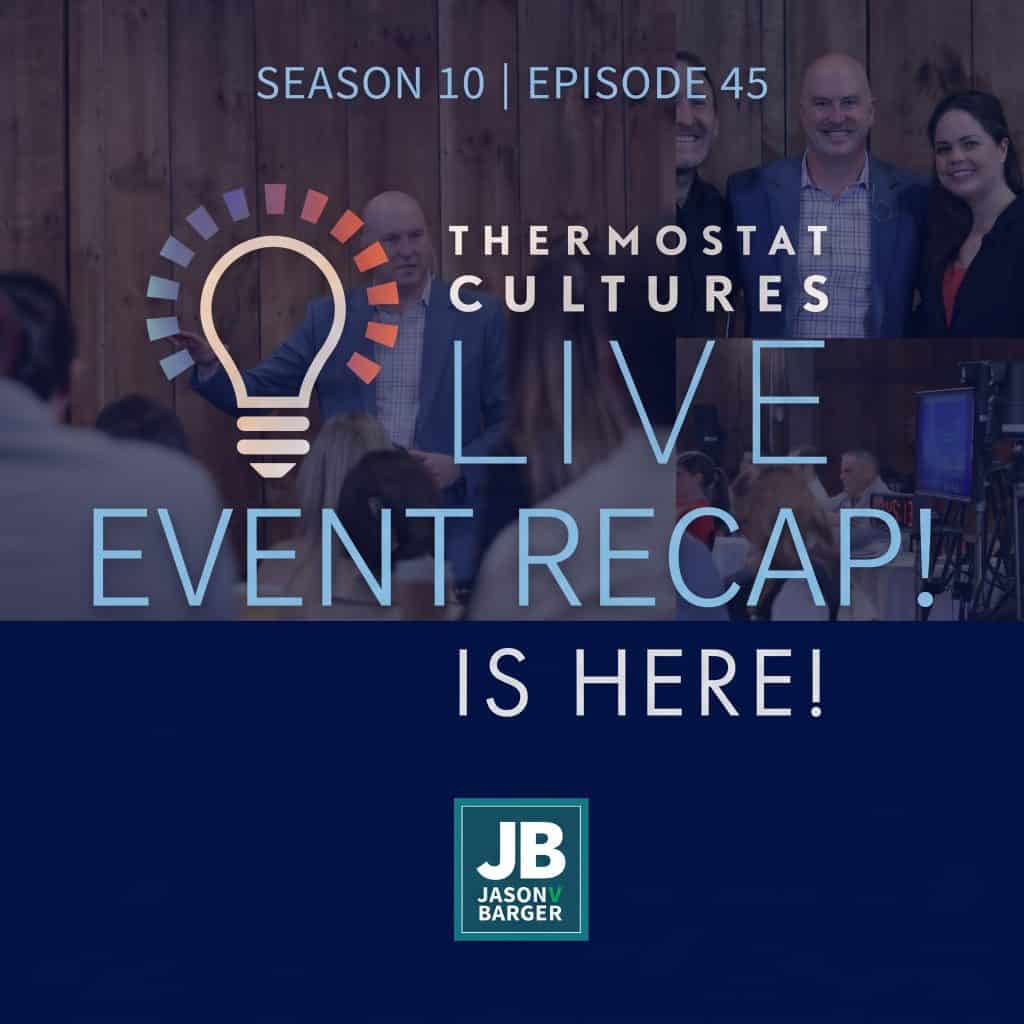
It was another powerful ThermostatCulturesLIVE.com event and this episode takes you into the room to hear some of the quotes and soundbites from the inspiring event!


SHOW NOTES
Jason introduces Season 10 episode 45 of the podcast, Thermostat Cultures LIVE Event Recap! Welcome back to the podcast on corporate culture and leadership and thank you for listening. We engage thought leaders like CEOs, CFOs, managers, VPs, directors, and more for this podcast. We wish to create content that engages your mind and heart and allows you to step back and think and add some positivity to your life. We deep dive into today’s topic.
We can’t control everything but what we can control is our response. Still a lot of work to do but wanted to remind the audience what is within our control is the temperature we create in the organizations and teams we work with.
Please leave a review for the podcast It really helps the podcast to spread these messages out into the world. Please share this podcast with your organization, on your team, or in your life to help spread these messages. Thank you!
If any of these topics are interesting to you please or you want a deep dive on any specific topics, please reach out to us here
Thermostat Cultures LIVE Event Recap!
The energy in the room at Thermostat Cultures Live 2026 proved that when leaders intentionally pause the daily whirlwind, meaningful organizational transformation begins. Hosted in Columbus, Ohio, and streamed virtually worldwide, the 10th-anniversary gathering brought together executives, team leaders, and cultural architects across diverse industries. Rather than reacting to workplace friction, attendees gathered to calibrate their leadership thermostats, interrogate their internal narratives, and explore the practical conditions that build high-trust corporate culture.
Executive Summary
Modern organizations operate under unprecedented pressure to deliver quantifiable, bottom-line metrics. Yet, the differentiating factor between organizations that burn out and those that achieve sustained high performance is the deliberate cultivation of leadership in teams. Featuring practical insights from keynote speakers, C-suite executives, and cross-industry attendees, the 2026 Thermostat Cultures Live event centered on four core imperatives: defeating the limiting voice of the “inner dictator,” redesigning meetings as intentional organizational products, navigating artificial intelligence with trust and heart, and practicing empathetic accountability. This recap highlights the key takeaways, attendee stories, and leadership frameworks shared inside the room.
Mastering the Internal Narrative: Defeating the “Inner Dictator”
Social psychologist and author Owen Fitzpatrick challenged attendees to examine the most pervasive barrier to executive effectiveness: the stories we tell ourselves. Fitzpatrick pointed out that because human brains evolved with a primary mandate to ensure survival, they possess an inherent negativity bias, often creating fear-based scenarios that distort reality.
┌─────────────────────────────────────────────────────────────┐
│             DISMANTLING THE "INNER DICTATOR"                │
├──────────────────────────┬──────────────────────────────────┤
│ 1. RECOGNIZE PROPAGANDA  │ Identify that brain-created fear │
│                          │ is a narrative, not a fact.      │
├──────────────────────────┼──────────────────────────────────┤
│ 2. REGULATE THE BODY     │ Restore cognitive balance with   │
│                          │ sleep, movement, and nature.     │
├──────────────────────────┼──────────────────────────────────┤
│ 3. ASK BETTER QUESTIONS  │ Shift from "I am great" to       │
│                          │ "What is great about my team?"   │
├──────────────────────────┼──────────────────────────────────┤
│ 4. TEST UTILITY          │ Ask: "Does this story help or    │
│                          │ hurt my leadership mission?"     │
└──────────────────────────┴──────────────────────────────────┘
Fitzpatrick framed these persistent inner critics as an “inner dictator” speaking with absolute conviction. The critical discipline for leaders is to recognize this self-talk as inner propaganda rather than objective truth. Rather than debating whether an internal narrative is completely right or wrong, leaders must evaluate its utility: Does this story help me, or does it hurt me?
This principle resonated deeply with attendees across industries. Levi, a leader at NetJets, reflected on how an executive’s unspoken self-talk inevitably creates a ripple effect throughout their team:
-
The Leadership Mirror: When managers experience self-doubt or cynicism, those patterns silently manifest in the behaviors of their direct reports.
-
Intentional Modeling: By actively managing their internal stories, leaders establish a healthier, more grounded standard for their teams to emulate.
Treating Meetings as Products and Navigating AI with Heart

Dr. Rebecca Hinds, future-of-work researcher and author of Your Best Meeting Ever, introduced a foundational operational shift: treating organizational meetings like products.
In many corporate ecosystems, meetings represent the single largest investment of human capital, yet they remain the least optimized. Companies would never ship a customer-facing product without iterative feedback, clear design specifications, and continuous refinement, yet recurring calendar invites are deployed without rigor. By applying product design principles—tracking meeting metrics, pruning obsolete sessions, and scheduling deliberate “doomsday meeting” audits to shed low-value calendar clutter—organizations can reclaim cognitive bandwidth for high-impact collaboration.
[ Meeting as an Intentional Product ]
                 │
                 ├──► Define Clear Specifications & Objectives
                 ├──► Gather Iterative Participant Feedback
                 └──► Conduct "Doomsday" Calendar Audits to Prune Waste
Dr. Hinds also addressed the intersection of leadership trust and emerging technology. When employees possess high trust in their executives, they view AI implementation as an empowering capability enhancement. When trust is deficient, the exact same technology is perceived as an existential threat of displacement.
Attendees, including communications professionals from public school districts, underscored that while AI offers valuable operational leverage, it must never devolve into impersonal “AI slop”. Authentic employee recognition, student engagement, and team communication require human empathy and heart.
“The Gray Matters”: Operating Beyond the Metrics
Ally Carlotta from NetJets Headquarters highlighted why stepping away from the daily operational fire drill is critical for long-term health. While modern corporate culture places intense scrutiny on black-and-white performance metrics, return on investment, and quantitative dashboards, human performance is won or lost in the gray.
-
The Value of the Gray: Culture, empathy, and interpersonal safety do not fit into tidy spreadsheet rows. They are built during informal hallway conversations, moments of vulnerability, and deliberate check-ins.
-
The Outside Catalyst: Carlotta emphasized that bringing in outside perspective provides the spark required to facilitate essential, uncomfortable conversations that internal teams often avoid due to imposter syndrome or ambiguous ownership.
Empathetic Accountability: The “Ten and Two” Framework
Eric Piscopo, Chief Human Resources Officer at Elford Incorporated, shared the operational philosophy behind Elford’s achievement of being named a Top Workplace for eleven consecutive years: Empathetic Accountability.
Accountability cannot function as a punitive stick; it must be balanced with consideration for the personal context of each team member. When an employee struggles, high-impact leaders look beneath the surface to identify underlying stress or personal hardship, utilizing trust to address performance gaps constructively.
┌─────────────────────────────────────────────────────────────┐
│             THE "TEN AND TWO" CONNECTION HABIT              │
├─────────────────────────────────────────────────────────────┤
│ • Walk the workspace daily at 10:00 AM and 2:00 PM           │
│ • Meet employees on their home turf without an agenda        │
│ • Share specific, timely praise: "I'm hearing great things"  │
│ • Ensure the first chat isn't a corrective disciplinary one │
└─────────────────────────────────────────────────────────────┘
To build relational equity before problems arise, Piscopo practices his daily “Ten and Two” habit: walking the halls at 10:00 AM and 2:00 PM to connect directly with people on their turf. This intentional presence ensures that corrective conversations never take place in a vacuum of unfamiliarity.
Leaders from Germain Automotive Partnership similarly reinforced that deliberate culture summits serve as the necessary “glue” uniting multi-site enterprises. By aligning subcultures across 17 car dealerships around a shared vocabulary and mission, leaders ensure their entire workforce marches in the same direction.
Notable Quotes from the Event
“The first strategy to defeat any dictator is to realize he’s a dictator. The first way to challenge what he says is to realize it is propaganda. As soon as you recognize it as propaganda, it’s no longer the truth. It’s now just a story.” — Owen Fitzpatrick, Social Psychologist & Author
“All stories are made up. The real question is: Is it useful? Does this story help me or hurt me? If it helps you, great. If it hurts you, it ain’t worth believing in.” — Owen Fitzpatrick
“The things that I think about and the things that I reflect on, how they ripple effect down into my team… What are the stories I tell? Those are probably the things that they’re telling themselves, whether or not I think about it intentionally.” — Levi, NetJets
“Meetings are the most important product in our organizations. They’re where decisions get made, culture gets built, alignment gets set. And yet so often, they’re the least optimized product.” — Dr. Rebecca Hinds, Author of Your Best Meeting Ever
“What gets lost when we only focus on the black and white is what happens in the gray. The gray matters. It’s in the gray that we build culture, that we build relationships, that we understand what it’s like to feel being at work.” — Ally Carlotta, NetJets
“I wrote down ’empathetic accountability’… When you have people that are struggling and you want to hold them accountable, you have to be considerate that there might be something else going on in their lives causing them angst or stress.” — Eric Piscopo, CHRO, Elford Incorporated
“I don’t want the first time I have a tough conversation with somebody to be the first time I have a conversation with them.” — Eric Piscopo, CHRO, Elford Incorporated
“The best leaders and team cultures in the world are the ones that make time to step back, breathe in good oxygen, and calibrate their thermostat.” — Jason V. Barger
Questions to Ponder
To evaluate your organizational climate and calibrate your team’s thermostat for the season ahead, consider these reflection prompts from the close of the event:
-
What internal stories or “inner propaganda” are you currently entertaining, and are those narratives helping or hurting your executive effectiveness?
-
How are the unspoken stories you tell yourself rippling down into the expectations, attitudes, and behaviors of your team?
-
If you evaluated your organization’s recurring meetings as a customer-facing product, would you be proud of their design, utility, and output?
-
How can you implement empathetic accountability this week to ensure your team members feel seen and supported before challenging performance conversations occur?
-
What specific, proactive temperature do you intend to set for your organization over the coming year?
Is your team ready to become change-seekers? If you’re looking for further guidance on aligning your vision with action, how can we help you take that next strategic step? – Contact Us Now
Links and References
Learn more & visit ThermostatCulturesLIVE.com to learn more about the event
Ready to improve your corporate culture? Checkout TCL 2026 event this year and reserve your spot now. Visit Here
Follow @JasonVBarger on social media for even more insights and new video content.
For more insights and practical tips, be sure to check out Jason V Barger’s book Breathing Oxygen. This book dives deeper into the concepts discussed in this episode and provides additional strategies for fostering a positive mindset and effective leadership.
By incorporating these practices into your summer routine, you can breathe new life into your personal and professional endeavors. Remember, as Jason says, “The best leaders, teams, and cultures on the planet stimulate progress by recalibrating their thermostat together.”
Please leave a review for the podcast It really helps the podcast to spread these messages out into the world. Please share this podcast with your organization, on your team, or in your life to help spread these messages. Thank you!
If any of these topics are interesting to you please or you want a deep dive on any specific topics, please reach out to us at info@jasonvbarger.com
Listen to more great episodes here
Remember, the best leaders, teams, & cultures stimulate progress by recalibrating their thermostat together.
If you like the podcast, have a question, or just want to share your thoughts about daring to begin please leave a comment below or please leave a review on Apple Podcasts or Google Podcasts.
—

Barnes & Noble Amplify Books Publisher Amazon Books & Kindle
ABOUT THE THERMOSTAT
Conversations and micro-thoughts to engage your mind and heart.
A thermostat is proactive. It sets the temperature in a room. Controls the temperature. Regulates the temperature. But in today’s distracted, fast-paced and digital world, it’s easy for individuals and organizations to act more like thermometers, slipping into reactionary thinking, becoming scattered and inconsistent. The most compelling leaders, teams, organizations, families, or collection of humans of any kind operate in thermostat mode. They calibrate their mind and heart to set the temperature for the vision and culture they want to create. Jason Barger, globally celebrated author, keynote speaker, and founder of Step Back Leadership Consulting, is the host of The Thermostat, a podcast journey to discover authentic leadership, create compelling cultures and find clarity of mission, vision, and values.