
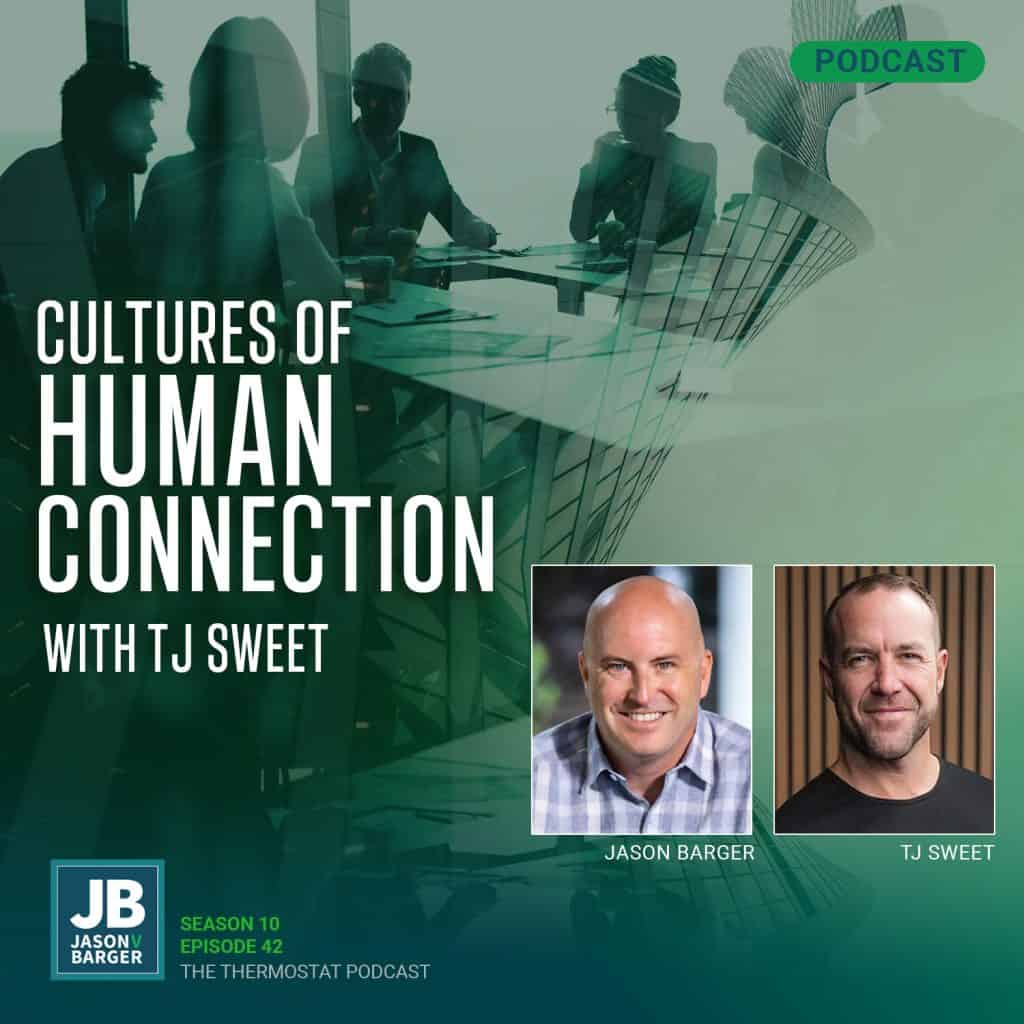
The most compelling and highest-performing leaders create cultures of connection and purpose with intentionality. Keynote speaker, TJ Sweet, joins Jason Barger for an inspiring chat.


SHOW NOTES
Jason introduces Season 10 episode 42 of the podcast, Cultures of Human Connection with TJ Sweet. Welcome back to the podcast on corporate culture and leadership and thank you for listening. We engage thought leaders like CEOs, CFOs, managers, VPs, directors, and more for this podcast. We wish to create content that engages your mind and heart and allows you to step back and think and add some positivity to your life. We deep dive into today’s topic.
We can’t control everything but what we can control is our response. Still a lot of work to do but wanted to remind the audience what is within our control is the temperature we create in the organizations and teams we work with.
Please leave a review for the podcast It really helps the podcast to spread these messages out into the world. Please share this podcast with your organization, on your team, or in your life to help spread these messages. Thank you!
If any of these topics are interesting to you please or you want a deep dive on any specific topics, please reach out to us here
Cultures of Human Connection with TJ Sweet
In high-performance business environments, success is routinely quantified through balance sheets, key performance indicators, and quarterly outputs. Yet, behind the metrics, an invisible crisis often brews: high achievers driving impressive results while quietly losing touch with the people, presence, and purpose that make that success sustainable. When leadership is reduced to transactional oversight, employee engagement withers, organizational trust erodes, and burnout takes hold.
On this episode of The Thermostat Podcast, host Jason V. Barger sits down with leadership coach, author, and speaker TJ Sweet. Drawing from more than two decades of leading teams in healthcare and oncology, Sweet shares a transformative perspective on modern workplace dynamics: true leadership is not measured by title or authority, but by how people feel, grow, and connect under your care. Building a resilient corporate culture requires moving beyond passive management and intentionally cultivating environments anchored in human connection, psychological safety, and shared accountability.
Executive Summary
Modern organizations are experiencing unprecedented levels of disengagement and workplace fatigue. While many executives blame external factors or workload volume, the root cause is frequently a deficit of meaningful human connection. When leaders rely on command-and-control authority rather than genuine connection, communication breaks down and cultural dissonance takes root.
This article outlines how leaders can redefine their impact by shifting from transactional management to relational empowerment. By exploring the power of intentionality, mastering the anatomy of courageous conversations, aligning actions with stated values, and reigniting purpose in the age of automation, executives can foster high-trust leadership in teams that drives enduring, exceptional performance.
Redefining Leadership: Beyond Title and Output
Traditional corporate structures often promote top-of-the-pyramid leadership—a paradigm centered on power, hierarchy, and directing others from above. However, the most influential leaders operate from a completely different posture: they view leadership as the privilege of serving a mission greater than themselves and unlocking the strengths of their people.
As Sweet observes from his extensive career, exceptional leaders do not create passive followers; they create other high-agency leaders. True authority is not established through executive presence or forceful commands, but through visible effort, attitude, and empathy. When leaders step into the room with humility, recognizing that their primary responsibility is to coach, support, and clear barriers, employees cease feeling like subordinate task-executors and begin acting as invested stakeholders.
The Cold Plunge Principle: Becoming the Cause, Not the Effect
A central metaphor in culture shaping is the distinction between a thermometer and a thermostat. A thermometer merely records the surrounding temperature, rising and falling reactively with external chaos. A thermostat intentionally sets and regulates the climate.
Sweet illustrates this proactive mindset through his personal discipline with extreme cold plunges. Sitting in 44-degree water, he noted a profound mental shift when watching the water temperature rise: The water was not making him cold; his body was actively warming the water.
┌─────────────────────────────────────────────────────────────┐
│                 THERMOSTAT VS. THERMOMETER                  │
├──────────────────────────────┬──────────────────────────────┤
│ THERMOMETER (REACTIVE)       │ THERMOSTAT (PROACTIVE)       │
│ • Reacts to external stress  │ • Regulates internal climate │
│ • Adopts toxic temperatures  │ • Radiates calm & conviction │
│ • Asks: "What is happening   │ • Asks: "What impact am I    │
│   to me?"                    │   bringing to this space?"   │
│ • Trapped in complacency     │ • Pushes edges for progress  │
└──────────────────────────────┴──────────────────────────────┘
In organizational life, leaders must ask themselves whether they are products of their environment or if the environment is a product of their presence. When leaders stop asking “What is being done to me?” and start asking “What am I doing to the situation?”, they reclaim their agency. Instead of absorbing office gossip, anxiety, or market friction, an authentic leader radiates stability and sets a constructive temperature for the entire organization.
Courageous Conversations Require Deep Connection
A critical test of leadership in teams is how conflict and accountability are handled. Many managers avoid difficult discussions or approach them with extreme dread. Sweet provides a diagnostic benchmark for leaders: If you experience overwhelming anxiety before a difficult conversation, it is often a sign that you have not built a foundation of trust and connection with that person.
In high-trust environments characterized by genuine psychological safety, accountability is predictable and supportive rather than punitive. Employees know what to expect because the leader’s intentions are clear.
To turn confrontational meetings into constructive breakthroughs, leaders must enter the room with a transparent framework:
-
Remove the Drama and Problem Obsession: Shift the dialogue away from finger-pointing and emotional posturing.
-
Clarify Action and Impact: Objectively detail the behavior that occurred and illustrate how it impacted the team, the client, or the mission.
-
Co-Create the Forward Plan: Human behavior requires knowing what to do differently, not just what went wrong. Develop a clear, reciprocal roadmap for progress.
-
Utilize Teach-Backs: Ask the team member to communicate the plan back in their own words to confirm alignment and ensure mutual understanding.
-
Establish Scheduled Follow-Ups: Scheduled check-ins eliminate the perception of micromanagement because accountability was built into the initial agreement.
When feedback is rooted in care and mutual respect, tough conversations strengthen professional relationships instead of shattering them.
Congruence vs. Cultural Dissonance: Giving Meaning to Words
Trust within a corporate culture hinges on congruence—the alignment between what leadership professes and what the workforce experiences every day. When organizations broadcast core values on office walls but tolerate toxic leadership behaviors behind closed doors, they create severe cultural dissonance.
Consider the word gratitude. Proclaiming broad, generic appreciation during an annual meeting rarely resonates. To make gratitude meaningful, leaders must pair it with specific, observable actions and deliver it in ways that individual team members actually receive.
Sweet suggests asking employees directly: “When do you feel seen, safe, valued, and appreciated?” Some thrive with public recognition; others are horrified by it and value a private, handwritten note or a quiet word in the hallway acknowledging a job well done. When leaders tailor their appreciation to the individual, employees realize they are recognized as complete human beings rather than interchangeable units of production.
The Antidote to Burnout in the Age of AI
As artificial intelligence and automated systems accelerate across industries, leaders face a crucial crossroads. While technological tools streamline operations, they also risk leaving employees feeling isolated, mechanized, and detached from organizational purpose.
Gallup research continues to highlight historic lows in employee engagement, with vast segments of the workforce craving genuine community and cultural alignment. Sweet emphasizes that burnout is rarely an issue of work volume alone; it is fundamentally a crisis of meaning:
[ Lack of Intentionality ] ──► [ Disconnection from Impact ] ──► [ Burnout & Fatigue ]
                                         │
                                         ▼
[ Daily Purpose & Questions ] ─► [ Relational Connection ]  ──► [ Energy & Resilience ]
When professionals forget why their contributions matter, exhaustion sets in. The solution is not merely throwing wellness perks at an overburdened staff. Leaders must intentionally infuse daily work with purpose by asking deeper questions:
-
“What brought you energy today?”
-
“What is something you handled this week that made you proud?”
-
“How did our team’s efforts directly improve the life of the person we serve today?”
AI will inevitably handle repetitive operational tasks, but it cannot manufacture empathy, inspiration, or authentic human alignment. As technology expands, human connection becomes an organization’s most valuable strategic differentiator.
Notable Quotes
“The best leaders are not defined by title, output, or performance alone. They are defined by how people feel, grow, and connect under their leadership.” — TJ Sweet
“Burnout isn’t a work problem. It’s a meaning problem. I’ve forgotten why it matters.” — TJ Sweet
“Great leaders create leaders, not followers.” — TJ Sweet
“The water’s not making me cold. I’m warming the water up… You can expand that in every area of life thinking: what’s being done to me versus what am I doing to it?” — TJ Sweet
“Grateful is just a word until we give it meaning, and until we put action behind it to show what it means to be grateful.” — Jason V. Barger
“When people see incongruence between our thoughts, our words, and our actions is when distrust and disengagement begins to happen.” — Jason V. Barger
Questions to Ponder
To evaluate your leadership approach and calibrate your organization’s cultural temperature, reflect on these questions inspired by the episode:
-
What temperature are you intentionally setting in your life and work right now—are you reacting like a thermometer or regulating the climate like a thermostat?
-
Where might cultural dissonance exist in your organization between what you publicly claim to value and how your team interacts on a daily basis?
-
Do you know specifically how each member of your team needs to receive appreciation in order to feel truly seen, safe, and valued?
-
How often are you deliberately reminding your team of why their work matters, ensuring that purpose remains at the center of their daily efforts?
Is your team ready to become change-seekers? If you’re looking for further guidance on aligning your vision with action, how can we help you take that next strategic step? – Contact Us Now
Links and References
Learn more about TJ Sweet and his work, visit TJSweet.com
Ready to improve your corporate culture? Checkout TCL 2026 event this year and reserve your spot now. Visit Here
Follow @JasonVBarger on social media for even more insights and new video content.
For more insights and practical tips, be sure to check out Jason V Barger’s book Breathing Oxygen. This book dives deeper into the concepts discussed in this episode and provides additional strategies for fostering a positive mindset and effective leadership.
By incorporating these practices into your summer routine, you can breathe new life into your personal and professional endeavors. Remember, as Jason says, “The best leaders, teams, and cultures on the planet stimulate progress by recalibrating their thermostat together.”
Please leave a review for the podcast It really helps the podcast to spread these messages out into the world. Please share this podcast with your organization, on your team, or in your life to help spread these messages. Thank you!
If any of these topics are interesting to you please or you want a deep dive on any specific topics, please reach out to us at info@jasonvbarger.com
Listen to more great episodes here
Remember, the best leaders, teams, & cultures stimulate progress by recalibrating their thermostat together.
If you like the podcast, have a question, or just want to share your thoughts about daring to begin please leave a comment below or please leave a review on Apple Podcasts or Google Podcasts.
—

Barnes & Noble Amplify Books Publisher Amazon Books & Kindle
ABOUT THE THERMOSTAT
Conversations and micro-thoughts to engage your mind and heart.
A thermostat is proactive. It sets the temperature in a room. Controls the temperature. Regulates the temperature. But in today’s distracted, fast-paced and digital world, it’s easy for individuals and organizations to act more like thermometers, slipping into reactionary thinking, becoming scattered and inconsistent. The most compelling leaders, teams, organizations, families, or collection of humans of any kind operate in thermostat mode. They calibrate their mind and heart to set the temperature for the vision and culture they want to create. Jason Barger, globally celebrated author, keynote speaker, and founder of Step Back Leadership Consulting, is the host of The Thermostat, a podcast journey to discover authentic leadership, create compelling cultures and find clarity of mission, vision, and values.